The Quantum World and Oneness
A Spiritual Reflection by Rev. Dr. Jeff Byrd
Why This Question Keeps Coming Up
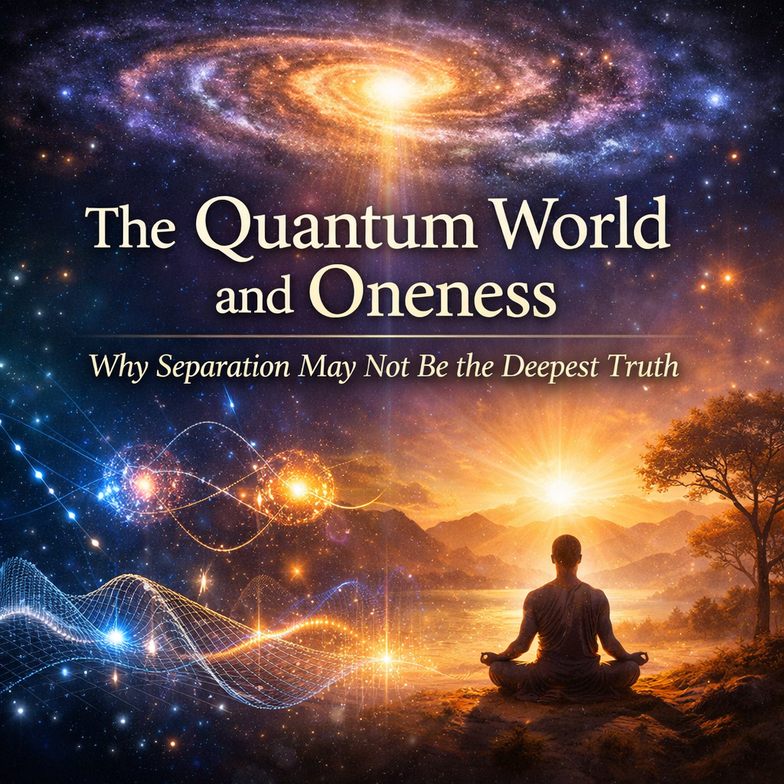
Does quantum physics prove that we are all One? No, but it offers discoveries that invite thoughtful reflection about connection and separation. Exploring those discoveries can deepen our wonder without asking science to prove our spiritual beliefs.
People have been drawing connections between quantum physics and spirituality for about a hundred years. Some comparisons open meaningful conversations. Others ask the science to say more than it does.
I’m not a physicist, and I don’t pretend to understand all the mathematics. I approach this subject as a New Thought minister who has practiced and taught Oneness for years. My interest is in exploring the connection honestly and considering what it might mean in daily life.
In New Thought, Oneness means there is one Life, one Presence, one Divine Reality expressing Itself everywhere. We appear separate, with different bodies, experiences, and personalities. Yet we belong to one another because we all belong to Spirit.
When I first read about quantum entanglement, something about it felt familiar. I didn’t see proof of Oneness, but I recognized a question worth exploring. Could reality be less divided than our everyday experience suggests?
What Is Quantum Entanglement?
Quantum physics describes matter and energy, including behavior that becomes especially noticeable at the scale of atoms and smaller particles. At that scale, our everyday expectations often fall short. Entanglement is one example.
Two particles can share a quantum state, meaning scientists must describe certain properties of the pair together. When measured, their results can show connections even when the particles are far apart. Scientists call these connections correlations, and experiments have demonstrated them repeatedly.
An ordinary comparison helps explain what makes this surprising. Imagine placing one glove in each of two boxes and sending them to different cities. Opening one box tells you which glove is in the other.
That connection isn’t mysterious because each glove was already left-handed or right-handed. Entangled particles behave differently in carefully designed experiments involving different measurement choices. Their results show correlations that cannot be explained simply by properties assigned beforehand and carried separately by each particle.
This challenges familiar ideas about how separate things behave. It does not mean one particle sends a usable message instantly to the other. Entanglement cannot be used to communicate faster than light.
What Does Observation Mean?
Another quantum idea often enters spiritual conversations: the role of observation. In quantum physics, a system can exist in a superposition, involving multiple possible outcomes for a particular measurement. When that measurement occurs, a definite result is recorded.
The word “observation” can be misleading because it sounds as though a person must consciously watch. In this context, measurement involves a physical interaction, such as a particle encountering a detector. The process does not require a human mind watching the instrument.
Physicists continue to debate how best to understand what happens during measurement. Those debates are fascinating, but they don’t establish that our thoughts directly control particles. We can appreciate the mystery without turning it into a claim the evidence doesn’t support.
Where I Find a Spiritual Parallel
Ernest Holmes taught that one Infinite Intelligence is present throughout creation. Within Science of Mind, we understand ourselves as expressions of that one Life. We participate in Life rather than standing outside it.
Quantum physics and this spiritual teaching are not saying the same thing. Entanglement describes measurable relationships within physical systems. Oneness expresses a spiritual understanding of our relationship with God, one another, and all life.
Still, I find something meaningful in considering them together. Quantum discoveries challenge the familiar picture of objects possessing entirely independent properties. They remind me that everyday appearances don’t tell us everything about reality.
For me, that reminder opens a door to wonder. It invites humility about what we know and curiosity about what we have yet to understand. It also resonates with my spiritual conviction that separation is not the deepest truth of our lives.
That resonance is a personal reflection, not a scientific conclusion. Physics does not establish that everything shares one Divine consciousness. My understanding of Oneness comes through spiritual teaching, reflection, practice, and lived experience.
Where the Comparison Has Limits
Respecting both science and spirituality means allowing each to speak honestly. We don’t need to force them into agreement. A meaningful connection can include clear differences.
Entanglement is not the same as human connection. It does not establish that two people who love each other share a special quantum bond. It also does not provide scientific evidence for telepathy or distant healing.
Quantum measurement does not demonstrate that thoughts create physical events. Our thoughts influence our attention, choices, actions, and relationships. That practical influence matters without requiring a quantum explanation.
Quantum physics applies beyond tiny particles, but everyday conditions matter. Interactions with the environment usually make delicate quantum behavior difficult to observe in ordinary objects. We cannot simply transfer findings about particles into claims about relationships, health, or personal success.
Oneness does not need quantum mechanics to be worth practicing. We can discover the value of compassion, forgiveness, and spiritual awareness through living them. Science can inspire our curiosity without carrying the responsibility for our faith.
What Oneness Changes in Daily Life
The question that matters most to me is practical. How does remembering Oneness change the way we live? What happens when we bring that awareness into an ordinary, difficult moment?
When I feel separate, I’m more likely to become defensive. I protect my position, compare myself with others, or assume someone else’s gain means my loss. Fear can make my world feel very small.
Remembering Oneness gives me another place from which to respond. Another person’s suffering matters because their life has the same sacred worth as mine. Compassion becomes a way of honoring the Life we share.
Consider a conversation with someone you love. They say something sharp, and you immediately feel the urge to respond in kind. In that moment, Oneness may feel like a lovely idea with little practical value.
This is where a simple practice can help. Before answering, take one breath and notice what is happening within you. Acknowledge the hurt without judging yourself for feeling it.
Then remember that both of you have dignity, even when the conversation is difficult. You might ask what they meant or explain how their words affected you. You might also need to set a boundary or step away.
None of those responses requires pretending the hurt doesn’t matter. Oneness includes your well-being as fully as the other person’s. Remembering our connection can support honesty and boundaries as well as kindness.
When We Believe It but Don’t Feel It
This is where I find Oneness hardest and most necessary. When life is painful, a relationship is strained, or fear takes hold, separation can feel overwhelmingly real. Spiritual understanding doesn’t make those feelings disappear.
We don’t have to deny our emotions to honor our spiritual nature. We can feel anger, sadness, or uncertainty while remembering that these experiences don’t define our whole being. Our feelings deserve compassion, not a spiritual argument.
Oneness is already true within the spiritual understanding I teach. Felt Oneness is our lived awareness of that truth. Practice helps us return to that awareness, especially when it feels distant.
Oneness also does not erase individuality. A wave is still a wave, with its own shape and movement. It is never separate from the ocean.
Each of us is a distinct expression of one Life. Our differences matter, and our experiences deserve to be heard. Recognizing our shared spiritual nature can help us honor those differences with greater care.
An Invitation to Wonder
Science and spirituality approach life through different questions and methods. Physics develops and tests explanations of how the physical world behaves. Spiritual practice explores meaning, our relationship with Spirit, and how we choose to live.
There is room to value both. We can respect scientific evidence while remaining open to spiritual insight. We can also admit what we don’t know without losing our sense of wonder.
Quantum physics doesn’t prove Oneness, but it reminds me that reality can exceed our familiar assumptions. My spiritual practice invites me to explore connection through the way I live. Daily life gives me opportunities to put that understanding into practice.
Where in your life does separation feel strongest right now? What might change if you brought one breath of awareness to that place? You don’t have to force a feeling of connection to begin treating yourself and others with greater care.
If these questions speak to you, you’re welcome to explore them with us at Center for Spiritual Living Minneapolis. Our recorded Sunday talks offer practical spiritual ideas you can consider wherever you live. You don’t need to be a member or have everything figured out to join the conversation.